
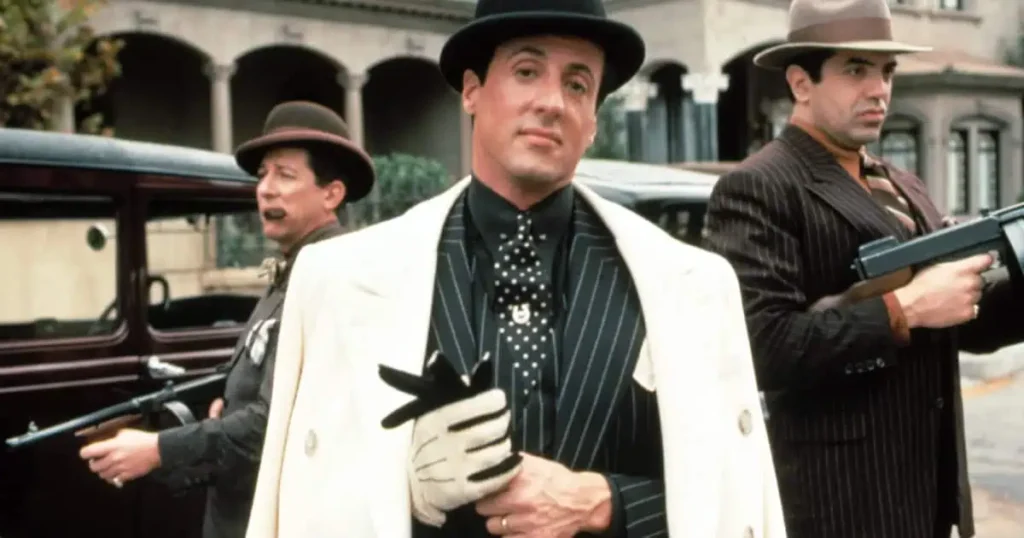


Today marks Sylvester Stallone’s birthday, making it a fitting moment to revisit one of the most misunderstood entries in his filmography: Oscar.
Released during a turbulent stretch of his career and initially dismissed as a miscast experiment, the 1991 gangster comedy directed by John Landis has slowly earned a different kind of reputation over time. Far from the critical reception it received on release, Oscar now sits in an unusual space in Stallone’s legacy, one where time has softened expectations, and the performance itself reads in a very different light.
On a day meant to celebrate Stallone’s career, it’s worth reconsidering whether this was really one of his missteps or one of his most overlooked creative risks.
Key Takeaways
- Oscar is a 1991 gangster comedy directed by John Landis starring Sylvester Stallone
- It emerged during a wave of 1980s action stars experimenting with comedy roles
- The film was released during a downturn in Stallone’s career and underperformed at the box office
- Critics rejected it in 1991, but modern reassessments are far more positive
- It remains one of Stallone’s strongest and most overlooked comedic performances
When Action Stars Started Doing Comedy
If you grew up in the 1980s, you probably remember when action stars inevitably tried their hand at comedy. It wasn’t just common, it felt like a rite of passage. At a certain point in every major action career, the pivot came. Most of them struggled with it. One, however, didn’t. That was Arnold Schwarzenegger.
Schwarzenegger’s success in comedy didn’t just work, it reshaped his entire career trajectory. But in the shadow of Arnold’s success story lies a forgotten experiment that history has largely dismissed: Oscar. And it might be the clearest proof that Sylvester Stallone was better at comedy than he’s ever been given credit for.

Clint Eastwood and the Blueprint for Action-Comedy
The modern action-comedy crossover arguably begins with Clint Eastwood in 1978. At the time, Eastwood was the biggest action star in the world. Known for grim, no-nonsense roles, he surprised audiences by pivoting into lighter territory with a film co-starring an orangutan named Clyde.
That film was a gamble. Industry insiders warned it would damage his image. Instead, it became a massive hit.
The success of that tonal shift quietly established a blueprint: audiences were willing to follow action stars into comedy if the execution worked.
Arnold Schwarzenegger and the Comedy Breakthrough
Years later, Arnold Schwarzenegger took that idea and refined it with Twins. Paired with Danny DeVito under director Ivan Reitman, Schwarzenegger’s comedic turn became a cultural reset. It expanded his audience far beyond action fans and proved he could carry an entire film on comedic timing alone.
The impact was immediate. After Twins, Arnold returned to action with even greater commercial momentum, leading into titles like Total Recall and Terminator 2. Comedy didn’t weaken him, it elevated him. And that wasn’t lost on his biggest rival.
Stallone vs Schwarzenegger: The Comedy Rivalry Era
The rivalry between Sylvester Stallone and Arnold Schwarzenegger was part marketing, part ego, and part genuine competition. One of the most famous jokes in Twins even has Arnold walking past a theater showing Rambo III, laughing at Stallone’s hyper-masculine image.
For Stallone, the message was clear: if Arnold could reinvent himself through comedy, so could he. But timing matters, and Stallone chose the worst possible moment to try.

Why Oscar Happened at the Worst Possible Time
By the early 1990s, Stallone’s career momentum was unstable.
- Rambo III underperformed expectations
- Lock Up flopped
- Tango & Cash performed modestly
- Rocky V was poorly received
Against that backdrop, committing to a full comedic farce was a risk few would have advised. But that’s exactly what happened when John Landis stepped in with a new project.
John Landis, Reinvention, and the Making of Oscar
Following a devastating career setback tied to the production of Twilight Zone: The Movie, John Landis was in need of a comeback. He turned to Disney’s Touchstone Pictures and revived a French comedy premise, reimagining it as a 1930s gangster farce infused with Damon Runyon-style dialogue.
The result was Oscar. Originally envisioned for actors like John Belushi or Al Pacino, the role of “Snaps” Provolone eventually went to Stallone, a casting decision that initially baffled critics.
Why Stallone Actually Works in Oscar
Against expectations, Stallone is not the problem with Oscar. He plays Snaps Provolone not as a loud gangster, but as someone constantly reacting to chaos around him. The performance is intentionally restrained, almost passive, which fits the structure of a screwball farce.
Rather than dominating scenes, he absorbs them. That choice makes him unexpectedly effective. He’s not trying to out-comedy the ensemble, he’s playing the straight man inside a collapsing world. And it works more often than critics acknowledged in 1991.
A Supporting Cast Built for Chaos
One of the film’s greatest strengths is its stacked ensemble:
- Peter Riegert as the perpetually confused Aldo
- Marisa Tomei in an early breakout role
- Ornella Muti as Stallone’s paranoid wife
- Chazz Palminteri, Kurtwood Smith, Tim Curry, Harry Shearer, and Don Ameche in standout supporting roles
Even Kirk Douglas appears in a memorable cameo, adding real-world tension due to his past connection with Stallone’s Rambo franchise development history.
Why Oscar Failed in 1991
Despite strong craft and a notable cast, Oscar was widely rejected on release. Critics were not kind. Audiences were even colder. Part of the problem was expectation mismatch: viewers expected action-era Stallone, not period farce dialogue and theatrical staging.
Commercially, it earned roughly $23 million domestically, a disappointment for a major studio release. But the film’s failure was not purely about quality; it was about timing and perception.

Why Oscar Looks Better Today
Modern reassessments of Oscar are significantly more generous. Seen outside its release context, the film plays as a tightly constructed farce with strong pacing, committed performances, and unusually disciplined direction from John Landis.
Most importantly, Stallone’s performance reads differently today. Without the weight of career expectations, it becomes easier to see what he was doing: playing against image rather than failing at comedy.
The Aftermath: Comedy, Recovery, and Legacy
Stallone had already begun work on Stop! Or My Mom Will Shoot around the same period, further complicating his comedic reputation. But he would rebound strongly with Cliffhanger and Demolition Man, reestablishing himself as a box office force.
Meanwhile, Schwarzenegger would later stumble with Last Action Hero, proving that even successful comedy pivots had limits. Still, the broader trend stuck: action stars doing comedy became the norm in the decades that followed.
Final Thoughts
Today, Oscar stands as a fascinating outlier in Stallone’s career: a film dismissed in its time, yet increasingly reevaluated as part of a larger shift in how action stars were allowed to evolve. It may not be the loudest or most iconic comedy of its era, but it might be one of the most misunderstood.
And for Sylvester Stallone, it remains proof that his comedic instincts were never the problem, the moment was.
FAQ: Oscar
Is Oscar (1991) a good movie?
Yes, if judged as a screwball gangster comedy. While initially dismissed, Oscar is now often reappraised as a well-crafted farce with strong performances, especially from Sylvester Stallone.
Was Oscar a box office failure?
Yes. The film earned approximately $23 million domestically and was considered a commercial disappointment on release.
Who directed Oscar (1991)?
The film was directed by John Landis, known for earlier hits such as Trading Places and The Blues Brothers.
Why did Sylvester Stallone do Oscar?
Stallone participated in a broader late-1980s trend where major action stars experimented with comedy following crossover successes like Twins.
Why was Oscar (1991) criticized at the time?
Critics and audiences expected an action-era Stallone performance. Instead, they received a stylized 1930s-inspired farce, creating a major tone mismatch.
Has Oscar (1991) been re-evaluated?
Yes. Modern reassessments are more favorable, with critics and audiences recognizing its craftsmanship, pacing, and committed ensemble cast.
What is Sylvester Stallone’s role in Oscar?
He plays “Snaps” Provolone, a gangster trying to maintain control of a collapsing situation, reacting rather than dominating, a key reason the performance works in context.
Why Oscar Matters Today
Oscar has gained renewed attention because it sits at a turning point in Hollywood history: when major action stars began experimenting with genre reinvention. In the wake of successes like Twins, studios increasingly encouraged established action icons to broaden their appeal. While some attempts succeeded and others failed, Oscar represents one of the most interesting case studies of that shift.
Today, as audiences reassess forgotten 1990s studio comedies and revisit “miscast” performances with modern perspective, Oscar is being reconsidered not as a failure, but as a tonal experiment that arrived before its audience was ready. It also highlights a key contrast in star evolution: while Arnold Schwarzenegger successfully transitioned comedy into long-term career momentum, Stallone’s experiment shows how timing, branding, and audience expectation can shape perception more than performance quality.
In that sense, Oscar is less about a failed comedy and more about a moment when Hollywood briefly redefined what an action star could be.



var VUUKLE_CONFIG = { apiKey: “ce56389c-23a7-4874-a8ae-971a18a84355”, articleId: “post880749”, img: “https://www.joblo.com/wp-content/uploads/2026/01/stallone-oscar-656×343.jpg”, tags: “”, comments: { toxicityLimit: 100 }, }; (function () { // 1. Define the loadVuukle function function loadVuukle() { if (window.vuukleLoaded) return; window.vuukleLoaded = true; // Set flag so the timer doesn’t fire var d = document; var s = d.createElement( “script” ); s.src = “https://cdn.vuukle.com/platform.js”; s.async = true; ( d.head || d.body ).appendChild( s ); } // 2. Check for Freestar if ( window.freestar && Array.isArray( freestar.queue ) ) { // Path A: Freestar exists. Push to queue to fix race condition. freestar.queue.push( loadVuukle ); // Set a 3-second watchdog timer. // If Freestar is blocked, our queue won’t be processed. // This timer will fire and load Vuukle as a fallback. setTimeout( function () { if ( !window.vuukleLoaded ) { // Flag was never set, Freestar must be blocked. loadVuukle(); } }, 3000 ); } else { // Path B: Freestar doesn’t exist. Load Vuukle immediately. if ( document.readyState === “complete” || document.readyState === “interactive” ) { loadVuukle(); } else { document.addEventListener( “DOMContentLoaded”, loadVuukle ); } } } )();
The comment section exists to allow readers to discuss the article constructively and respectfully, focused on the topic at hand.
What’s Not Allowed